
Welcome
Becky Ramsey | Author & Children’s Minister
Children's Sermons
Discover children’s sermons, or search our sermon directory

What is Godly Play?
According to the Godly Play Foundation, Godly Play is a creative and imaginative approach to Christian nurture.
Godly Play is about understanding how each of the stories of God’s people connects with the child’s own experience and relationship with God.
Godly Play respects the innate spirituality of children and encourages curiosity and imagination in experiencing the mystery and joy of God.
Read more about Godly Play here.
How do we do Godly Play at First Baptist Greenville?
Christians of many different denominations use Godly Play and probably do it differently, even within the same denomination. In this blog, I describe Godly Play by sharing the way our church does it. That doesn’t mean that it’s the best way or the prescribed way, or the only way, of course, but it’s the way that suits us best.
What are we here for?
We meet here to talk about Godly Play, to share what it’s all about and to discuss how to do it better.
The weekly blog posts are designed to help Sunday school teachers prepare for their Godly Play lessons, and the individual pages (see the tabs at the top of this page) share information about how we do Godly Play at First Baptist Church, Greenville, SC.
We’d love to hear from teachers everywhere, not just the ones at our church! We hope you’ll join our circle and share your ideas!
What Godly Play is Not
Godly Play is quite different from the traditional model in which the teacher tells the children what they need to know. Godly Play is not about things that are that simple. It is not just about learning lessons or keeping children entertained. It is about locating each lesson in the whole system of Christian language and involving the creative process to discover the depths of meaning in them.
The Parable of the Great Pearl
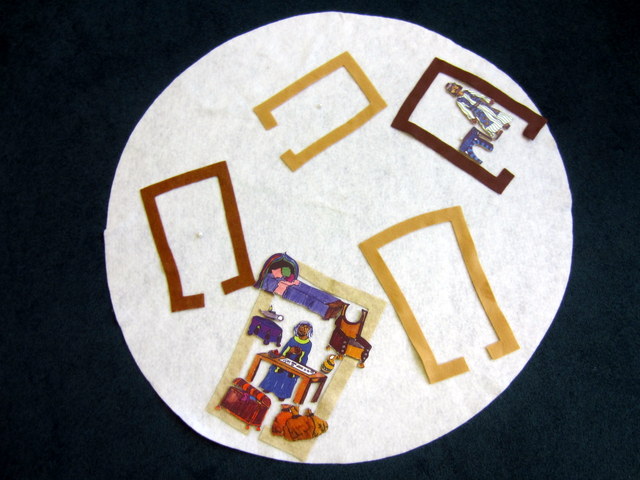 Welcome to the Parable of the Great Pearl, based on the scripture found in Matthew 13:45-46.
In a world like ours which places such importance on having things, this story gives us a chance to explore the greatest treasure one can possess: God’s kingdom and a relationship with God. What does it mean to sell all that we have to obtain this treasure? I bet the kids can help us figure this out.
The wondering questions are in the book. They include:
1. I wonder if the person was happy with the great pearl.
2. I wonder what the merchant is going to do now.
3. I wonder why the seller was willing to give up something so precious.
4. I wonder if the seller has a name.
5. I wonder if the merchant has a name.
6. I wonder what the great pearl could really be?
7. I wonder what could be so precious that a person would exchange everything for it?
8. I wonder if you have ever come close to the great pearl.
9. I wonder where this whole place could really be.
Thank you for having an adult take time to jot down the children’s responses to these questions.
Idea Sparkers for Our Give a Gift to God Time:
1. Make a “pearl” necklace. Hobby shops (Michaels, Hobby Lobby) has fake pearls that you can string. Each student could make themselves a necklace using one pearl and yarn, along with whatever other work they choose to do today.
2. What does the kingdom of God look like? What makes it such a priceless treasure?
Children could draw a mural together or individual pictures. What could they show people doing in the kingdom of God? Is nature in the kingdom of God? How are people treating nature and each other?
3. Children could make their own parable set, so they can retell this parable.
4. Make/buy a “pearl” snack to share. Maybe vanilla wafers to make the oyster shell and then frosting in between with a pearl of a dot of white frosting or a white jelly bean?
See more ideas on my Pinterest page, here.
Thanks, y’all!
Becky